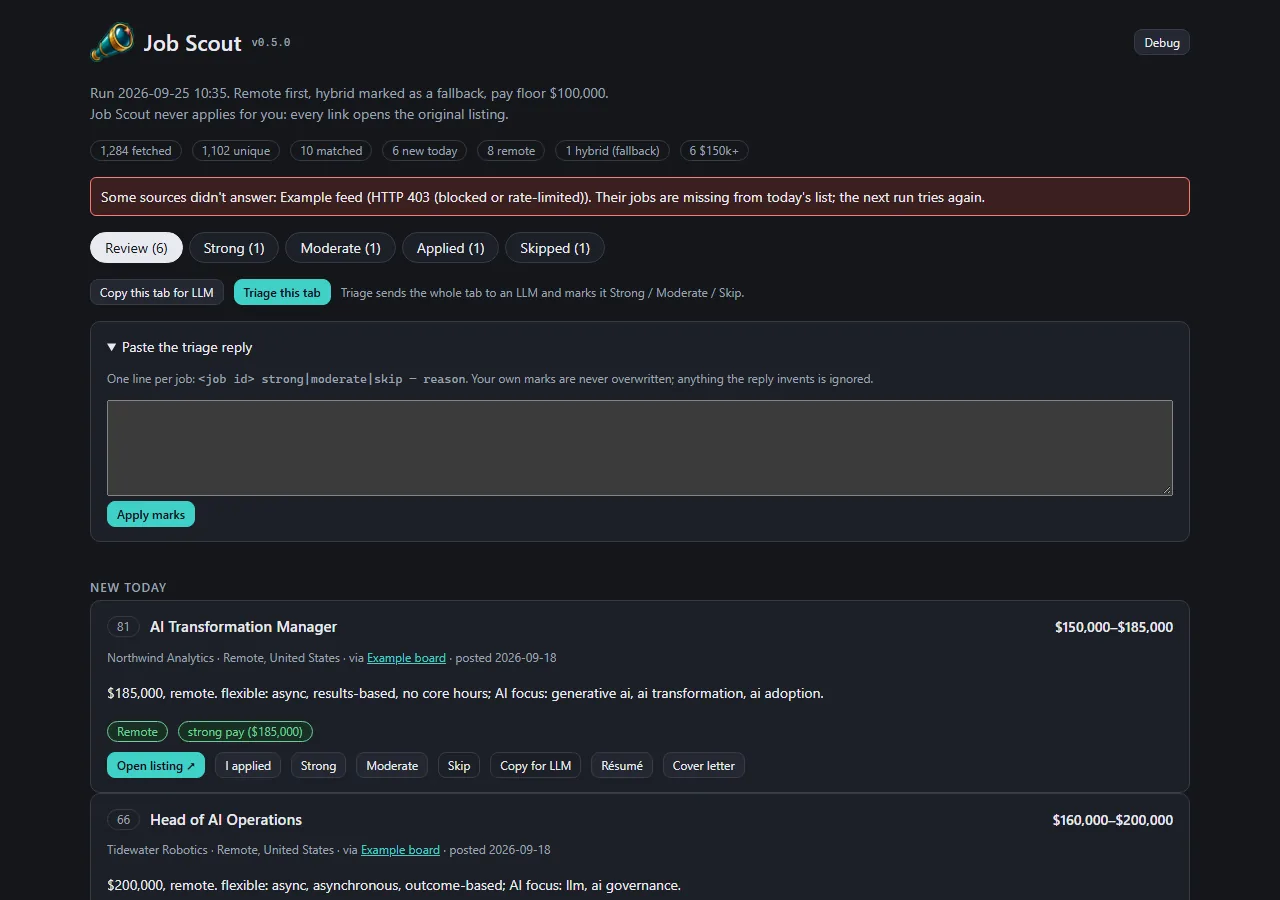
Triage this tab copies every job showing as one compact batch — id, title, employer, pay, workplace and a trimmed description — with a prompt asking for strong, moderate or skip and one short reason per job. Paste the reply back into the box on the page and the marks land in the store. A real day's list is about 150 jobs, which is one paste.
The filters stay in code; only the judgement is delegated. The hard rules — pay floor, US-only, remote-first, disqualifying titles — cut thousands of listings to about 150, and they're cheap, deterministic and the person's own. What a keyword scorer can't do is tell that a plain title over a description full of adoption and operating-model work beats an on-the-nose title at a staffing firm. That's the part worth sending.
The parser trusts nothing it didn't send. A line's job id must be one of the ids in the batch, so an invented id can't mark a real job; it's counted as ignored and reported back. The format is otherwise forgiving, because models wander from any format given 150 items.
A person's own mark always wins. Triage marks are recorded as machine-made, and a job the person marked themselves is left alone and counted as kept. The reply's reason is stored with each mark, so a later pass can tell a machine's guess from a person's judgement.

 Job Scout